

Managing a small business these days can be challenging. There is intense competition, limited budgets, and finding the right customers can feel like a never-ending battle. In the last several years, many tools that were once seen as costly or complicated are now becoming available to even the smallest stores and QR codes are at the forefront.
QR codes are no longer just a passing technological novelty. Rather they are a fast, inexpensive, and powerful mechanism for helping businesses go digital virtually overnight. From connecting with customers to capturing sales, these small codes can accomplish big results.
The Expansion of the Use of QR codes in Business
The use of QR codes has exploded across many different industries. Since 2020, QR code usage has increased over 400%, demonstrating that consumers feel comfortable scanning codes for purchases, product information, reviews, and offers.
Small business owners don’t need an information technology department to join in. Effective and easy to use applications like QR Meta allow for all levels of tech ability to create, customize, and monitor QR codes in just a few minutes. From linking customers directly to a menu or a social media application to participating in a promotional campaign, QR codes make digital connections possible.
6 Reasons : SMEs Should Pay Attention to QR Codes in 2025
1. Low-Cost Marketing
In marketing, printed materials – flyers, posters, brochures – can put a dent in a small business budget quickly. They can do that, but just one QR code can replace having to print all of those. The QR code opens digital content for the consumer to enjoy.
For example:
- Link one QR code to a seasonal catalog, instead of printing hundreds of brochures.
- Share promotions and discounts without spending additional marketing money for printing materials.
- Change/update your content whenever you want if you use dynamic QR codes, meaning that any time you have a new promotional offer or coupon, the single QR code can always point the consumer to the correct webpage, and there is no need to re-design or re-print business cards or flyers.
Advantage: You save money and the ability to stay relevant with what marketing provides credibility to your brand.
2. Immediate Engagement with a Consumer
QR codes can be scanned and immediately engage with your customers; one scan can take them to:
- Your online store or your physical menu.
- Social pages on Instagram, TikTok, or even LinkedIn – an opportunity awaits your customers to see what’s happening with your business and ultimately engage with you.
- Promos, discounted visits, loyalty programs, or a sign-up form
Example: A little bakery has small QR codes placed on its storefront window that links to the “daily specials” page. This helps walk-by customers see what specials they have going on today without asking questions or asking staff. Just having a simple QR code can lead to more traffic and greater sales.
Advantage: Having QR codes practically eliminates friction and the anxieties a consumer may have in connecting and engaging with you; it creates a fast and easy path to connect on the spot.
3. Measurable Results
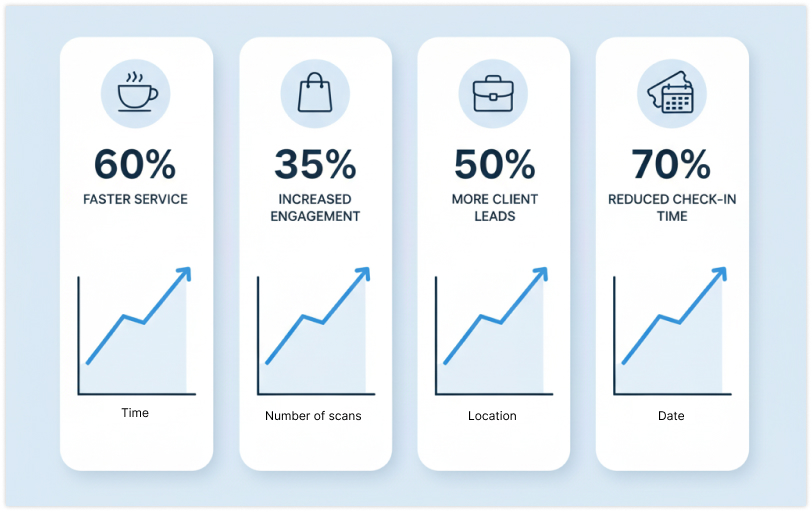
Dynamic QR codes provide measurable results for how your campaigns are functioning. You can measure:
- Number of scans.
- Time and date of scans.
- Location of your scanners (provided you want to use this information for local marketing).
Example: A boutique store prints out QR codes on tags located on their products that are linked to tutorials or styling suggestions. By seeing how many times they’re scanned each week, they’ll know particular products have the most traction and engagement to inform their marketing.
Advantage: Small businesses can have data-initiated decisions and insights that were previously only possible for big corporations while developing data to inform marketing efforts.
4. Environmentally Friendly
Consumers are more inclined to purchase from a sustainable company. QR codes help eliminate the number of paper materials needed:
- Digital menus instead of printed menus when at a café or restaurant.
- E-receipts instead of printed receipts.
- Online flyers versus having pages printed in mass.
Example: A local café may commit to a QR coded menu, reducing printing materials, while providing insight that they are taking eco-friendly measures. Customers may feel good eating at a restaurant with intentionality to reduce waste.
Advantage: Buys brand loyalty and increases new customers that value the environment and sustainable practices.
5. Establish Customer Trust
A custom QR code can reflect your brand’s identity: colors, logo and design etc., which enhances professionalism and integrity.
- Generic black and white codes tend to look robotic or inaccessible.
- If the code is branded in some manner it provides a professional approach and indicates you cared enough to take the time to ‘brand’ the QR code.
An example is a modest jewelry business, which has QR codes embedded on its packaging that connects to product care directions and authenticity certificates. The customer sees the business as professional and trustworthy.
Advantage: Confidence building and repeat customers.
6. Simple Application
- QR codes can appear virtually anywhere and do not require expertise.
- Packaging, invoice, receipt, menu, or business card.
- Emails, flyers, social posts, or even in store locations.
An example is a freelance photographer who adds a QR code to their business card so that individuals can access their portfolio instantly. They will be more inclined to reach out if they can see work examples.
Advantage: A seamless way to embed digital content in both physical and online customer experiences.
Real World Examples of QR Code Usefulness
- Local cafe: Uses QR codes on tables for a digital menu and customer feedback. This reduces the customer waiting time for ordering and enables them to get quick marketplace insight.
- Boutique shop: Use QR codes to direct customers to Instagram to view products and get inspired.
- Freelancer: Add a QR code to the business card that provides instant access to a portfolio of work.
- Event planner: Uses QR codes to scan tickets and RSVP online versus paper.
The Future of Small business marketing
QR codes are not just a fleeting fad; they are part of a larger digital revolution that combines low cost, accessibility, and measurement. They offer small businesses tools that only big brands could previously access, promoting egalitarianism in marketing and creating effective marketing tools for a fraction of the cost.
In 2025, it will not matter how big your marketing budget is; it will matter how clever and resourceful you are in using the tools at your disposal.
Conclusion: Small Codes, Big Results
QR codes are easy to use, low cost, and powerful. They allow small businesses to interact with customers, measure results, and appear professional – at a small fraction of the cost.
Start small. Add a single QR code to your business today. Because in 2025, every QR code scan could become a new customer.
FAQ
1. Why should small businesses use QR codes in 2025?
QR codes are affordable, simple to use, and help small businesses connect with customers instantly – no large marketing budget or tech team needed.
2. How can QR codes save money on marketing?
A single QR code can replace printed materials like brochures and flyers by linking directly to digital content, reducing printing costs and waste.
3. Can QR codes show how well a campaign is performing?
Yes! Dynamic QR codes track data such as the number of scans, location, and time, helping businesses measure engagement and improve marketing strategies.
4. Are QR codes eco-friendly?
Absolutely. They reduce the need for paper materials like menus, receipts, and flyers, supporting sustainable and environmentally friendly business practices.
5. Where can businesses place QR codes?
Anywhere! On packaging, menus, posters, business cards, emails, or social media posts – making it easy for customers to connect instantly.