
The corporate sector is increasingly transitioning to the use of self-service – not just as a means of cutting down costs, but because they must respond to the changing demands of customers who value speed and independence. Customers today want quick interactions where they get the chance to discover, choose, and act independently without relying on employees.
QR codes have emerged as a key solution towards achieving the same. Through the combination of QR code marketing and smart digital interfaces, organizations can facilitate an effortless and contactless customer journey. It empowers users while improving operational efficiency.
Why is Self-Service the Future?
The conventional model of service may depend too much on employees for each customer encounter, whether it is about delivering information or processing orders. Such a process is time-consuming, particularly at busy times. Self-service eliminates this problem through direct customer access to their needs. The key to achieving this lies in QR codes, which give customers direct access to menus, products, information, and services with just a few clicks.
QR codes play a central role here. With a quick scan, customers can instantly access menus, product details, contact information, or services – without waiting or asking for assistance.
Step 1: Start with a Digital Entry Point
Each instance of self-service starts with a convenient access point. The solution? QR codes. QR codes can be placed on tabletops, product packaging, store windows, or promotional items to offer immediate entry into the digital realm.
Consider a QR code for a digital menu. It enables diners to browse menus, tailor their orders, and make payments without ever having to leave their seats. This reduces wait times and improves order accuracy while supporting contactless ordering.
Step 2: Replace Traditional Business Cards
Networking and the relationships with customers are also changing. Instead of using traditional business cards made from paper, organizations are now opting for QR code business cards. A simple scan is all it takes for customers or partners to save contact information, access a website, or even make social media connections.
By creating a qr code generator for business card or qr business card generator, organizations can easily create a profile that can be edited anytime, ensuring that the contact information is always current without any need for reprints.
Step 3: Automate Customer Interactions
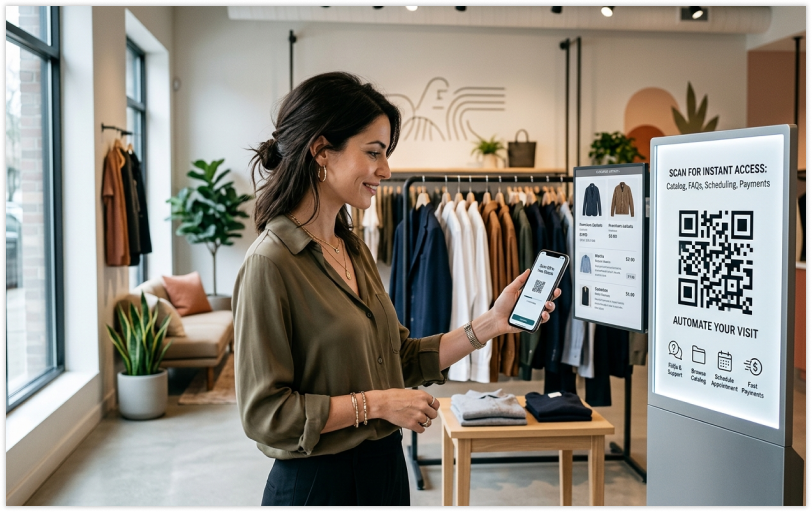
The effectiveness of self-service decreases the necessity of human intervention. With the help of QR codes, a number of customer services could be automated, including:
- FAQs or support pages
- Appointment scheduling
- Catalog browsing
- Payment processing
The benefits of automation not only increase efficiency but also allow customers to interact without any interference.
Step 4: Employ QR Code Marketing to Attract Customers
Self-service does not necessarily entail passive customer interaction – it needs to be active in encouraging action. The use of QR codes advertisements enables firms to link their offline audience to the online environment instantaneously.
By incorporating QR codes into these items, the clients will be able to access whatever promotions, landing pages or any other material that may be found on the digital world. Thus, the effectiveness of QR code marketing is improved through the transformation of these materials to interactivity.
Step 5: Prioritize Contactless Solutions
There is now a greater demand for contactless customer experience that is no longer considered a luxury but a necessity. Using QR codes gives businesses the ability to decrease the amount of human-to-human interaction while offering exceptional services at the same time.
This is regardless of whether it is to order food contactlessly at restaurants, book a stay in hotels, or attend events – the use of QR codes makes things easier for the customers.
Step 6: Centralize and Simplify the Customer Journey
Simplicity is another important benefit of implementing self-service. In the past, companies had to force customers through numerous hoops; however, by utilizing QR codes, all of that information could be stored in one location.
Through a single code scan, for example, a user could access all kinds of services, support, and transactions without being bogged down.
Step 7: Monitor and Improve Your Performance

QR codes are not just devices for gaining entry but also serve to provide useful information. Companies can keep tabs on how many times the QR code is being scanned, what activities people are performing, and where they are doing so.
Through this process, companies will be able to improve their marketing strategies based on the use of QR codes.
Real-World Example
Imagine yourself going inside a coffee shop in which everything happens in a self-service manner. Having scanned the QR code of the menu that is posted on the wall, customers will make orders using their smartphones along with paying for those services. When exiting from the coffee shop, customers need to scan one more QR code so as to stay in touch with the coffee shop and provide their feedback. The contact information of the staff is also presented in a QR code business card.
If it becomes necessary to reach out to the coffee shop staff, one can use the QR code business cards for contacting.
Conclusion
Creating a self-service model does not need complicated mechanisms; it is about utilizing the simplest methods for the right purposes. QR codes present an effective means for minimizing unnecessary procedures, maximizing ease, and providing a smooth contactless experience for customers.
Through adopting innovations such as qr code advertising, digital menu QR codes, and qr business card generators, companies can build systems that are effective, scalable, and customer-friendly. With growing expectations, organizations that embrace a self-service model through the use of QR codes will be well-prepared for future developments.
FAQs
1. What is a self-service business model?
A self-service business model allows customers to access information, place orders, or complete actions on their own without direct assistance, often using digital tools like QR codes.
2. How do QR codes support a self-service model?
QR codes provide instant access to digital content such as menus, payment systems, or contact details, reducing the need for manual interaction and enabling a smooth, independent experience.
3. What is a QR code business card?
A QR code business card is a digital alternative to traditional cards. When scanned, it shares contact details, websites, or social profiles instantly without requiring manual entry.
4. Which tools can I use to create QR code business cards?
You can use a qr code generator for business cards or a qr business card generator to create customizable and dynamic QR-based contact cards for your business.
5. How does QR code advertising help businesses?
QR code advertising connects offline materials like posters or packaging to online platforms, allowing customers to instantly access promotions, websites, or product information.